


Quick Summary: Selecting an eCommerce platform based on your long-term business goals, not popularity. Compare SaaS, open-source, and headless options by evaluating total cost of ownership, scalability, security, mobile performance, and integrations. The right choice today can reduce costs and support growth for years to come.
In an era when digital commerce is accelerating rapidly, launching an online store is only half the battle. According to the U.S. Census Bureau, domestic eCommerce sales are projected to reach $1.3 trillion in 2026, while global online retail continues to grow exponentially. This mass of digital buyers has turned the market into a highly competitive arena.
To stay ahead, businesses cannot afford to run their operations on outdated, clunky, or restrictive software. Choosing the right eCommerce platform is a basic business decision that dictates your scalability, business efficiency, and ultimately, your customer experience.
Why the Right eCommerce Platform is a Make-or-Break Decision
An eCommerce platform is not just another electronic shopping cart but rather the brain of your business. An eCommerce platform handles a range of functions, including inventory management, payment processing, shipping coordination, and data collection.

Choosing an eCommerce platform in blind faith can cost you your business, as it may lead to catastrophic bottlenecks. An eCommerce platform without API support will struggle to integrate with your warehouse management system. An eCommerce platform with poor code structure will struggle to handle peak times like Black Friday.
With mobile commerce now accounting for roughly 60% of global eCommerce sales in 2026, your chosen technology must deliver a flawless, mobile-first, omnichannel experience.
Types of eCommerce Platforms: An Objective Comparison
Not all eCommerce platforms are built the same. Generally, enterprise and mid-market eCommerce platforms fall into three distinct architectural categories.
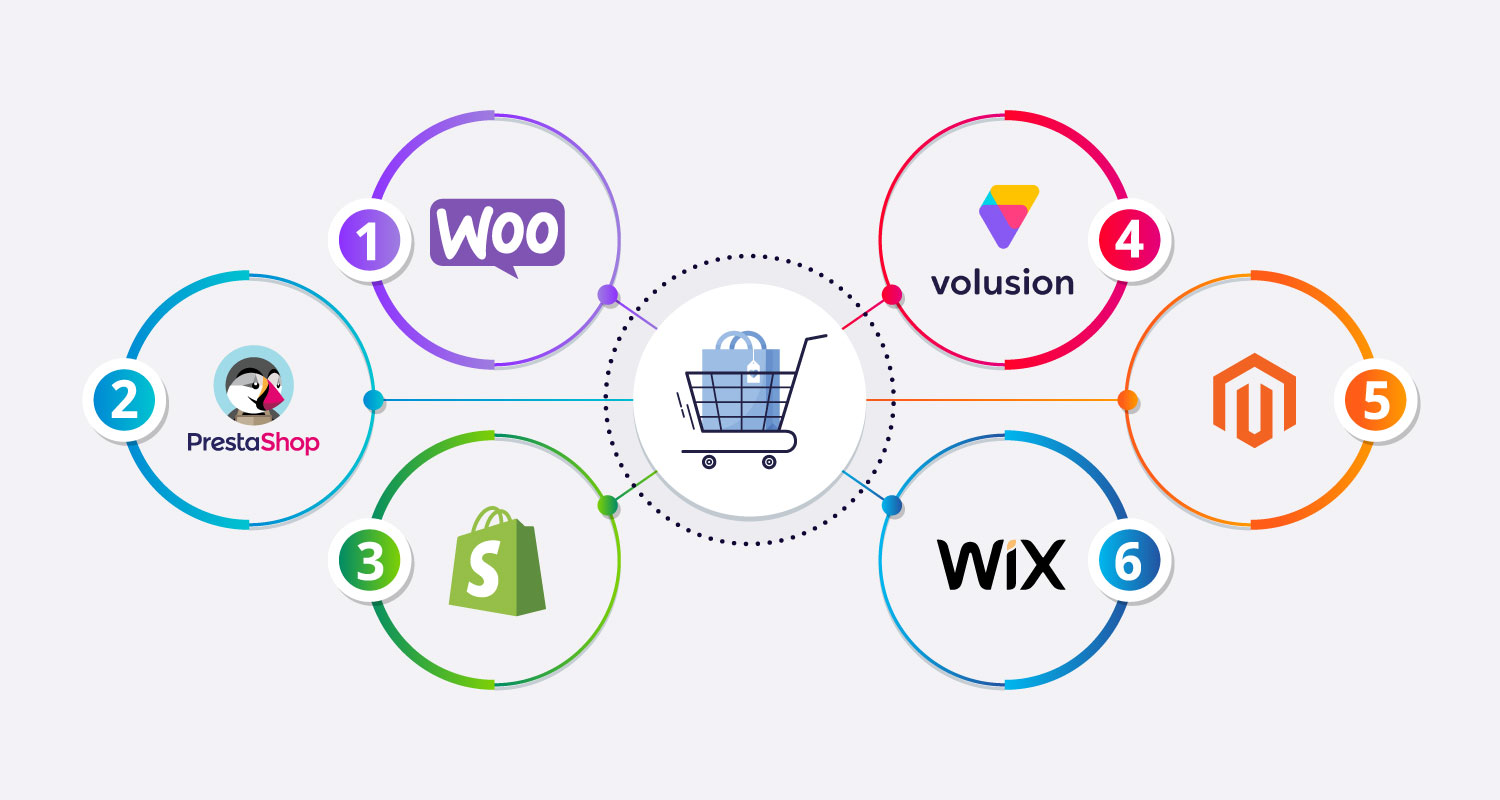
1. Open-Source eCommerce Platforms
Open-source platforms (like Magento/Adobe Commerce and WooCommerce) provide users with full access to the source code. You are responsible for hosting, securing, and supporting the environment. CMARIX, a Magento Development Company, is here to help you. Just keep scrolling to understand the steps required to select the right platform for your eCommerce stores.
- Pros: Limitless customization. You own the code and can mold the platform to fit highly complex product catalogs or unique B2B checkout workflows.
- Cons: Requires major technical expertise. You bear the burden of manual security patches, server maintenance, and hosting costs.
- Best For: Large enterprises or specialized B2B merchants with complex IT infrastructure and dedicated development teams.
2. SaaS (Software as a Service) eCommerce Platforms
SaaS platforms (like Shopify and BigCommerce) operate on a subscription model where the vendor hosts the software in the cloud. You rent the technology rather than owning the core code.
- Pros: Extremely fast time-to-market. The vendor handles PCI compliance, security, server scaling, and software updates. It generally lowers the barrier to entry.
- Cons: Less freedom for deep, underlying code customization. You are subject to the vendor’s roadmap and potential transaction fees or API rate limits.
- Best For: Startups to large enterprise brands looking for high reliability, ease of use, and lower IT overhead.
3. Headless Commerce Platforms
Headless commerce decouples the frontend presentation layer (what the customer sees) from the backend commerce engine (where transactions happen), connecting the two via APIs.

- Pros: Ultimate frontend flexibility. You can use any Content Management System (CMS) like WordPress or a Digital Experience Platform (DXP) to build lightning-fast web pages, smartwatches, or IoT displays.
- Cons: The most complex to set up. It requires managing multiple distinct technology stacks (the frontend framework and the backend engine).
- Best For: Omnichannel brands focused heavily on content-driven commerce and lightning-fast mobile speeds.
Read More: The 8 Biggest Trends That Will Transform the eCommerce Industry.
A Quick Comparison to the Best eCommerce Platforms

BigCommerce
| Pros | Cons |
| Industry-leading multi-channel selling natively built-in (no extra apps needed) | Rigid pricing tiers automatically force upgrades when store sales volume thresholds are crossed |
| Robust out-of-the-box SEO | Steeper learning curve compared to beginner-focused platforms like Shopify |
| No transaction fees across any of its standard subscription plans | High-end design templates and custom adjustments often require a developer or coding knowledge |
| Excellent native B2B functionality and enterprise-grade scalability | Limited free themes compared to what competitors offer in their native storefronts |
Adobe Commerce (Magento)
| Pros | Cons |
| Near-unlimited customization and complete control over database logic | Massive server requirements requiring costly dedicated hosting environments |
| Seamless multi-store management from a single, centralized backend dashboard | Highly expensive deployment due to the need for specialized Magento certified developers |
| Deep enterprise architecture specifically tailored for complex corporate B2B environments | No built-in virtual customer support; you are completely responsible for your own troubleshooting or maintenance |
| Massive open-source global community offering thousands of highly advanced extensions | Complex upgrade paths where minor version updates can break heavily modified stores |

WooCommerce
| Pros | Cons |
| Complete platform ownership because it is built entirely on top of open-source WordPress | Total maintenance responsibility (you must configure hosting, speed optimization, and security yourself) |
| Extremely cost-effective entry since the core platform plug-in is entirely free | Hidden extension costs stack up quickly when adding basic elements like premium payment gateways |
| Unrivaled flexibility with hundreds of thousands of themes and specialized functional plugins | No direct help desk or centralized support, leaving you to rely strictly on forum troubleshooting |
| Native blogging powerhouse giving your store maximum content marketing capabilities | Performance scales poorly if the underlying WordPress database is not meticulously managed |
Shopify
| Pros | Cons |
| Blazing fast loading speeds powered by a fully hosted, fully managed global CDN infrastructure | Mandatory transaction penalties if you choose not to use their proprietary Shopify Payments gateway |
| Exceptionally easy setup featuring a highly intuitive drag-and-drop website editor | Heavy reliance on monthly apps which can quickly balloon operational overhead costs |
| Massive ecosystem supported by thousands of partner apps, expert agencies, and community developers | Rigid checkout limitations unless you upgrade to the highly premium Shopify Plus tier |
| Top-tier native SEO tools coupled with unparalleled marketplace and social media checkout systems | Strict variant limits (maximum 3 options per product unless using heavy app workarounds) |
6 Crucial Factors for Choosing an eCommerce Platform
When evaluating vendors, look beyond the marketing buzz. Base your decision on these six rigorous business metrics.

1. Total Cost of Ownership (TCO) & Hidden Costs
Do not evaluate an eCommerce platform based solely on its monthly subscription or licensing fee. Industry research from firms such as Gartner and Forrester consistently shows that nearly half of all eCommerce projects exceed their projected budgets due to hidden costs.
TCO calculation for 3 to 5 years should encompass the following:
- Initial Acquisition: Software licensing, hosting, and implementation/development costs.
- Operating Costs: Payment gateway fees, premium app/plugin subscriptions, and third-party integrations (ERP/CRM).
- Cost of Innovation: Ongoing maintenance, feature upgrades, and retained agency support.
2. Speed and Capacity
Your platform must be fast. A delay of just one second in page response can result in a 7% reduction in conversions. Furthermore, the platform must scale elastically. If your marketing team launches a viral campaign, your server infrastructure must handle the quick influx of 10,000 concurrent users without degrading the customer experience. Cloud-hosted SaaS and well-architected Headless platforms generally excel here.
3. Security and PCI Compliance
For online merchants, cybersecurity breaches are common. Your eCommerce website needs to incorporate robust security measures, including DDoS protection, SSL certificates, and fraud detection. In case of opting for a SaaS eCommerce solution, you will get a Level 1 PCI-DSS certification. But when choosing an Open-Source solution, you will have to ensure all security requirements are met on your own.
4. Ecosystem: APIs, Plugins, and Third-Party Tools
No eCommerce platform operates in isolation. It needs to be integrated with your extended technology stack. Those are marketing automation tools (Klaviyo, Mailchimp), ERPs (NetSuite, SAP), and CRMs (Salesforce). Take a look at the platform’s apps market and API capabilities. The platform has to have a good REST or GraphQL API.
5. Payment Gateways and Global Shipping
70% of customers abandon their shopping carts, and one of the main reasons for that is a complicated checkout process. That is why your platform should support a wide range of payment gateways, including Apple Pay, Google Pay, BNPL services, and multi-currency payments for international sales. Besides, it should support integrations with the leading shipping and logistics companies.
6. User Experience (UX) and Theme Flexibility
Users expect an easy-to-use and visually appealing experience when shopping online. Consider the range of themes and templating systems supported by the platform. Does the theme automatically accommodate mobile devices? Is it easy for the marketing department to change banners or design landing pages without the need for coding skills? A robust drag-and-drop website builder helps you achieve maximum efficiency.
Conclusion: Partner with the Experts
Today, the market is swamped with software vendors making impressive promises, yet there is no universal answer. The selection of an eCommerce platform should be based on knowledge of your business model, user demographics, and technical limitations. The choice of the platform that meets your TCO and expandability needs will determine your success in 2026 and beyond.

If you are struggling to deal with the complexities of platform evaluation, TCO analysis, or a difficult data migration, you don’t have to do it alone. CMARIX is a world-class eCommerce development company with years of experience building, migrating, and scaling digital storefronts.
Ready to boost your online sales and build a future-proof technology stack? Contact the CMARIX team today to receive a no-obligation consultation and tailored quote for your next eCommerce project.
What is the most widely used eCommerce platform?
Shopify and WooCommerce are the most widely used eCommerce platforms in the world, depending entirely on how usage is measured.
Which eCommerce platform is best for SEO?
Platforms like BigCommerce and Magento have been commended for their built-in SEO features, which allow customization of URL structures and metadata. Nonetheless, any platform can be optimized for search engine visibility if done by competent developers.
Is it better to build a custom eCommerce website or use a platform?
For 99% of businesses, building a platform entirely from scratch is a waste of time and money. Using an existing SaaS, Open-Source, or Headless framework provides a secure, proven foundation, allowing you to allocate your budget to custom UX design and integrations rather than reinventing the digital shopping cart.
What is the difference between B2B and B2C eCommerce platforms?
B2B eCommerce refers to business-to-business e-commerce transactions, whereas B2C refers to business-to-consumer e-commerce. In B2B eCommerce, there is more complex purchasing and higher transaction volume, whereas in B2C eCommerce, the purchasing process is easier and driven by consumer emotions.
How much does it cost to migrate to a new eCommerce platform?
Replatforming costs vary widely depending on catalog size, dataset complexity, and the number of integrations. A basic migration might cost $10,000 to $30,000, while migrating a massive enterprise catalog with custom ERP integrations can easily exceed $100,000 and may reach $300,000+.
Do I need a developer to manage my eCommerce platform?
If you choose a SaaS platform like Shopify, day-to-day management (adding products, fulfilling orders) can be done without a developer. However, for custom theme design, advanced API integrations, or managing an Open-Source platform, partnering with an experienced development agency is highly recommended.