

Quick Summary: Ever wondered how top trading firms use Python to compete in microsecond markets? This blog reveals the architecture, tools, and techniques behind Python-driven HFT systems, from signal research to real-time execution, and shows how to build trading technology that actually wins.
Python has become the strategic language of modern finance. Most trading firms rely on Python to build research pipelines, develop signals, simulate strategies, and manage real-time risk. The growth of algorithmic trading and automated finance has pushed Python to the center of every major FinTech operation.
Although Python is not the fastest language at runtime, it offers unmatched speed in research, testing, and intelligence modeling. This is why Python in FinTech is now considered essential. Trading firms, hedge funds, and emerging platforms depend on Python developers to create fast, analytical, and scalable systems that react to markets with precision.
This guide explains how Python powers high-frequency trading, real-time analytics, modern risk engines, and low-latency systems development. It also explains how leading firms use Python as the intelligence layer while relying on compiled languages for execution. The focus is practical and engineered for readers who want to build algorithmic trading systems that can compete in modern electronic markets.
Why Python Dominates FinTech and Trading Technology
Python succeeded in FinTech for one core reason. It speeds up innovation.
In trading, the speed of idea development has more value than the speed of execution. Python provides quick signal testing, running thousands of simulations, analyzing microstructure data, and creating predictive models without complex boilerplate code.
Financial companies rely on:
- AI-driven trading solutions
- Real-time market data processing using Python
- Financial analytics platform development
- Custom algorithmic trading development
- Cloud-based trading infrastructure
All of these are easier with Python because the ecosystem supports fast iteration.
Python is now the preferred foundation for research teams, quant developers, and firms offering FinTech software development services.
The Latency Challenge: How Speed Controls Market Outcomes
High-frequency trading represents the most competitive segment of automated finance. In HFT, reaction time decides whether a strategy wins or loses.
Latency is the delay between receiving a market event and sending a trading decision back to the exchange. Modern firms measure it in microseconds.
If multiple participants detect the same opportunity, the one with the lowest latency captures the trade. The others miss it completely.
Key latency factors include:
- Distance between servers and exchanges
- Network path quality
- Hardware acceleration
- Kernel bypass
- Message queue efficiency
- Complexity of the trading logic
- Efficiency of the execution engine
Python is not ideal for the execution segment. Instead, companies use Python for the intelligence component and delegate execution to C++ or Rust. This approach enables high-frequency trading with Python without slowing down the critical trade path.
The Python Paradox: Slow Interpreter, Fast Innovation Cycle
The well-known paradox is simple.
Python is not the fastest language on the CPU, but it is the fastest language for building trading ideas.
Python is used for:
- Feature engineering: Turning raw market feeds into meaningful variables that actually strengthen predictive models.
- Alpha modeling: Designing models that try to spot short-term return opportunities before the rest of the market does.
- Signal research: Digging through data to uncover repeatable patterns that can serve as reliable trading signals.
- Exploratory backtesting: Running early, lightweight tests on historical data to see whether an idea shows real promise.
- Microstructure analytics: Studying order book behavior, spreads, and execution flow to understand how trades really behave in the wild.
- Real-time monitoring: Keeping a constant watch on live predictions, executions, and unexpected market behavior as conditions change.
- Data pipeline orchestration: Managing the entire flow of data, such as ingestion, cleaning, and transformation, so models always receive accurate, timely inputs.
- Risk model evaluation: Checking how a strategy holds up under volatility, stress events, and different market rules.
Compiled languages handle:
- Nanosecond-level order routing
- Exchange API communication
- Quote updates and feed parsing
- Queue management
- Fill response handling
Companies that excel at algorithmic trading adopt a polyglot architecture. Python works like a logic engine. C++ or Rust takes the role of the execution engine. Hardware accelerators, such as FPGAs(Field-Programmable Gate Arrays), handle deterministic tasks. This model allows financial teams to use a Python algorithmic trading library for building systems that combine speed and intelligence without compromise.
We create efficient, high-performance trading solutions with low latency, robust architecture, and future-ready scalability.
Contact UsPython’s Analytical Power: The Engine Behind Strategy and Risk
The true value of Python in FinTech appears before any order reaches the exchange. Python provides a deep analytics layer for studying patterns, volatility, execution quality, and risk.
Leading quant teams depend on Python for algorithmic trading because it supports:
- Large-scale market data processing
- Historical tick modeling
- Order book reconstruction
- Pattern discovery
- Predictive analytics
- Real-time data engineering services
- Machine learning based forecasting
- Deep learning driven signal detection
Python trading algorithms generally start with simple features and evolve into advanced microstructure models as the requirements scale.
Which are the Top 8 Core Python Libraries Used in Trading
| Library | Role |
| pandas | Time-series alignment, market data wrangling |
| NumPy | Fast numerical operations |
| scikit-learn | ML models for classification and regression |
| PyTorch and TensorFlow | Deep learning architectures |
| vectorbt | Vectorized high-speed backtesting |
| Backtrader and Zipline | Strategy simulation frameworks |
| Numba | JIT compilation for custom math |
| pandas-datareader | Historical data retrieval |
pandas
pandas is the backbone of financial data handling. Traders rely on it for cleaning messy datasets, resampling intraday bars, aligning timestamps, and structuring price and volume features before they enter models or backtests.
NumPy
NumPy is one of the most reliable and foundational libraries in quantitative finance. It delivers speed, structure, and arithmetic capabilities required to work with large volumes of market data. Financial workloads involve heavy numerical computations that need to be fast and reliable, and NumPy delivers exactly that.
scikit-learn
scikit-learn provides traders with a robust set of machine learning algorithms, including random forests, gradient boosting, logistic regression, and SVMs. It is commonly used to classify signals, filter noise, and build regression models that try to forecast short-term price movements in quantitative trading.
PyTorch and TensorFlow
These frameworks support deep learning models such as LSTMs, CNNs, and Transformers, as well as reinforcement learning setups. They are essential for strategies built on sequence modeling, sentiment extraction, and high-dimensional alpha signals.
Vectorbt
Vectorbt makes backtesting extremely fast. It can turn almost everything into NumPy-style vectorized calculations. Doing so is especially useful for researchers who want to quickly experiment with thousands of parameter sets without being slowed down by complex Python loops.
Backtrader and Zipline
Backtrader and Zipline provide traditional event-driven backtesting. They are useful for simulating realistic market behavior, including order handling, slippage, commissions, and broker events. This makes them ideal for strategy prototyping and walk-forward analysis.
Numba
Numba speeds up Python code that would otherwise be too slow for handling real-trading workloads. Many financial calculations need custom math, tight loops, and performance-critical logic, and Numba turns these Python functions into fast machine code with JIT (just-in-time) compilation.
pandas-datareader
pandas-datareader is used in the FinTech industry as it provides researchers a quick and reliable method to pull financial data directly into a Python environment. Since most trading workflows start by collecting historical prices, macro indicators, or fundamentals, having a lightweight tool that connects to common data sources is a great asset.
Note: For companies looking to outsource Financial analytics platform development services to a reliable Python development company, it is essential to ensure the developers are well-versed in these Python libraries and have experience in the finance industry.
How to Design Modern Trading Signals in Python
Signal design is the intellectual core of any trading system. Python provides teams with analytical flexibility needed to generate signals from technical indicators, market microstructure, statistical patterns, and ML-driven models.
Technical Indicators: SMA, EMA, RSI
Classic indicators remain foundational for early signal design. They help establish trend, momentum, and volatility conditions before moving deeper into analytics.
- SMA/EMA: Identify directional bias and smooth out intraday noise.
- RSI: Highlights momentum extremes for mean-reversion or breakout signals.
- MACD, ATR, Bollinger Bands: Frequently used in intraday models where volatility shifts matter.
These indicators act as the baseline layer before more advanced features are added.
Microstructure Features: Market Depth, Order Book Slope, Queue Prediction
Modern electronic markets reward firms that understand microstructure better than competitors.
Python enables the extraction of advanced features such as:
- Market Depth Imbalance: Measures the imbalance between aggressive buying and selling pressure.
- Order Book Slope: Detects hidden liquidity, iceberg orders, and liquidity walls.
- Queue Position Prediction: Models how fast an order will reach the front of the queue.
- Spread Dynamics: Identifies when spreads will widen or contract.
- Microprice and Fair Value Estimates: More accurate than mid-price signals.
Backtesting and Simulation: The Heart of Trading Strategy Validation
Backtesting evaluates whether a strategy idea can survive real market conditions. This phase is critical because most strategies fail long before deployment.
Python backtesting tools support:
- Tick-by-tick replay
- Slippage modeling
- Market impact simulation
- Latency simulation
- Order fill probability modeling
- Volatility stress testing
- Drawdown analysis
Backtesting is where quant teams make or break a strategy. Most firms consider it the most important stage in the algorithmic lifecycle.
Python in Low-Latency and Real-Time Environments
JIT Acceleration and Asynchronous Processing
- Numba JIT compilation for math-heavy workloads
- asyncio for event-driven workflows
- PyPy for reduced overhead in certain environments
- Multiprocessing and shared memory for parallelism
Common Python optimization techniques include:
- JIT Acceleration with Numba: speeds up computation-heavy Python functions by compiling them into fast machine code.
- Asynchronous event loops with asyncio: allow trading systems to handle real-time events efficiently without blocking execution.
- Memory-Optimized Data Handling: ensures that large market datasets are processed, stored, and streamed with the lowest overhead.
- High-Throughput Messaging with ZeroMQ and Kafka: Messaging systems like ZeroMQ and Kafka enable high-throughput communication between data feeds, strategy engines, and execution services.
What are the 5 Core Components of a Python-Driven High-Frequency Trading System?
| Sr No. | Component | Main Responsibility | Other Responsibilities |
| 1 | Market Data Feed Handlers | Capture and normalize real-time exchange data at ultra-low latency |
|
| 2 | Strategy Engine | Generate trading decisions using predefined logic or ML models |
|
| 3 | Order Management System (OMS) | Manage order submission, modification, and cancellation |
|
| 4 | Risk Management Layer | Enforce limits, prevent violations, and avoid harmful behavior |
|
| 5 | Execution Layer | Transmit final orders to the exchange with minimum possible latency |
|
How CMARIX Helps You Build High-Frequency, Low-Latency Trading Systems using Python
At CMARIX, we follow a structured development roadmap designed for firms that demand speed, precision, and scalable market performance. Each phase combines skilled Python engineering, quant workflows, low-latency optimization, and advanced AI integration.
Phase 1: Research and Strategy Discovery
- Define asset classes, liquidity windows, volatility behavior, execution constraints, and risk boundaries.
- Use Python-driven algorithmic research to explore hypotheses, extract edge patterns, and validate signal directions.
Phase 2: Architecture Planning and Infrastructure Blueprint
- Plan co-location, network topology, storage layers, language stack, and hardware acceleration.
- Choose between a cloud-based trading infrastructure or a hybrid setup.
Phase 3: Market Data Engineering and Feed Pipeline Construction
- Build real-time market data ingestion frameworks and depth-of-market engines.
- Implement high-performance data processing using Python, C++, and event-driven microservices.
Phase 4: Strategy Development and Modeling
- Develop signal logic, microstructure models, reinforcement learning models, and event-response pipelines.
- Integrate AI-driven forecasting, order-flow analysis, and short-horizon prediction modules.
Phase 5: Backtesting, Stress Testing, and Forward Testing
- Replay historical tick data, simulate edge cases, evaluate slippage, and fine-tune risk models.
Phase 6: Execution Engine and Low-Latency Integration
- Develop order routers, smart routing logic, queue prediction, and exchange adapters.
Phase 7: Deployment and Reliability Engineering
- Deploy resilient Python-based trading systems with redundancy, compliance controls, and full audit trails.
- Set up CI pipelines for rapid strategy updates, verification, and safe rollouts.
You can look forward to AI consulting services for FinTech to integrate predictive modeling, automate risk intelligence, improve strategy lifecycle efficiency, and support decision-making.
How Much Does It Cost to Build a Python-Based Trading System?
The budget for a Python trading system depends on several variables, including complexity, strategy type, and latency needs. Development costs vary with project complexity, from an MVP to a fully optimized, enterprise-grade platform.
| System Type | Description | Typical Range (USD) |
| MVP Strategy | Single exchange, basic signal research, and execution | 40K – 80K+ |
| Mid-Tier System | Multi-market, real-time risk dashboards, moderate automation | 100K – 250K+ |
| Enterprise-Grade Platform | FPGA integration, low-latency tuning, redundancy, multi-exchange pipelines | Unlock custom price tailored to your project. Get consultation with our experts now! |
Key points:
- Costs increase with more markets, faster execution, and more advanced AI/ML models.
- Backtesting, market data feeds, and regulatory compliance also influence budgets.
- Many companies lower costs by using hybrid models, where Python handles analytics and signal generation in the cloud, while the execution engine remains co-located for minimal latency.
We deliver high-performance, scalable trading platforms designed for reliability, security, and a competitive market advantage.
Contact UsBest Practices for Building Trading Systems with Python
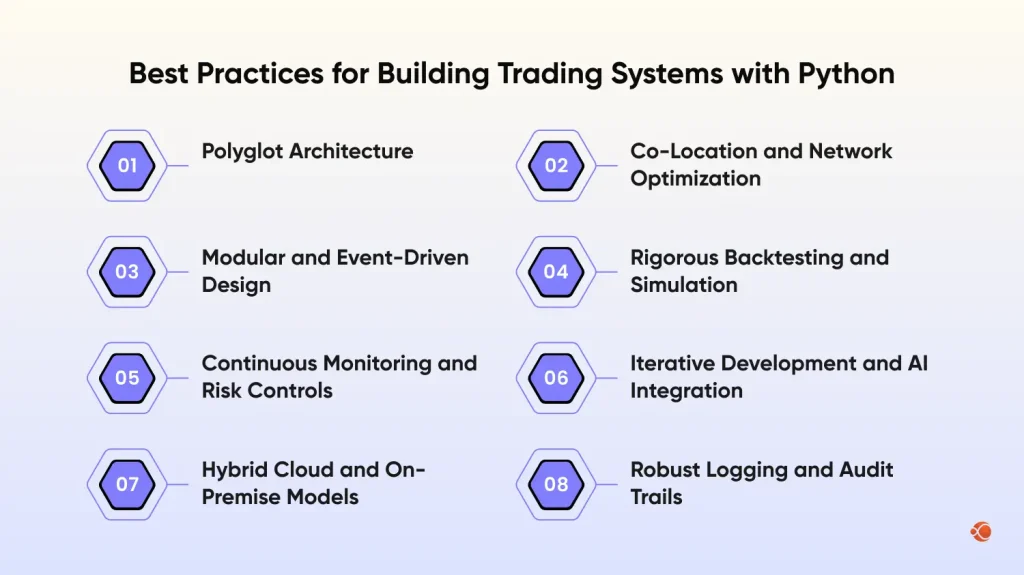
Here are some of the best practices we follow at CMARIX to build the most resilient Python-based trading systems that are fast, reliable, and scalable. Adopting such approaches can deliver significant performance gains, reduce errors, and optimize costs.
1. Polyglot Architecture
Use Python for risk management, data analysis, research, and generating trading signals because it’s flexible and powerful. For parts where speed is important, like executing trades, it uses faster, low-latency languages like C++ or Rust.
2. Co-Location and Network Optimization
Place your servers physically close to the exchange’s data centers to minimize data travel time. Optimize network connections with ultra-fast data transfer techniques, including bypassing the kernel to further reduce delays.
3. Modular and Event-Driven Design
Structure your system into clear layers, for example, one for market data, another for strategy decisions, risk, and execution. Use asynchronous, event-driven workflows so the system can efficiently manage a constant stream of real-time data without getting bogged down.
4. Rigorous Backtesting and Simulation
Test your strategies thoroughly by replaying the market tick by tick, simulating slippage and latency. Stress-test your strategy by putting it under extreme market conditions to ensure it holds up before you go live.
5. Continuous Monitoring and Risk Controls
Keep an eye on your trading signals, check for open positions, and any unusual behavior in real time. Automatically enforce risk limits to stop trades if exposure becomes too high or an unexpected event occurs, preventing large losses.
6. Iterative Development and AI Integration
Quickly try out new strategies using Python’s rich ecosystem of tools. Incorporate machine learning and predictive analytics tactics to improve your signals over time, helping you spot profitable opportunities and edges more accurately.
7. Hybrid Cloud and On-Premise Models
Use cloud infrastructure for heavy analytics and research tasks that don’t require immediate execution. Keep the trade execution engines on-premise or in co-location to maintain ultra-low latency and fast market access.
8. Robust Logging and Audit Trails
Keep detailed logs of every trade and decision to comply with regulations and to make reviewing strategies easier. This also ensures you can reproduce past decisions and quickly troubleshoot any issues that arise.
Final Words
Using Python in Fintech is not a new concept, and it has proven its worth as a preferred choice for building or optimizing any financial software. While compiled languages and hardware accelerators handle execution-critical tasks, Python AI-driven trading solutions drive research, strategy development, signal generation, and risk modeling, making it the backbone of algorithmic trading systems that compete at modern market speeds.
FAQs on Using Python in Fintech
Is Python good for high-frequency trading?
Python is widely used in HFT research, signal development, backtesting, and risk modeling because of its speed of iteration and rich ecosystem.
While pure Python isn’t fast enough for microsecond performance, firms pair it with C++, Rust, or optimized extensions to achieve production-level latency.
What is the single greatest performance bottleneck for Python in a trading loop?
The main bottleneck is Python’s Global Interpreter Lock (GIL), which limits true parallel execution of CPU-bound tasks.
This becomes critical when processing millions of ticks per second or running tight execution loops that demand nanosecond precision.
Beyond execution speed, how is Python best used for real-time risk calculations in FinTech?
Python excels at orchestrating risk pipelines, computing Greeks, VaR, and performing scenario modeling using optimized libraries such as NumPy, Pandas, and PyTorch.
Most firms offload heavy math to underlying C/C++ kernels while Python coordinates calculations, aggregation, and dashboards.
How does Python handle the high volume of real-time market data ingestion (e.g., tick data)?
Python typically manages ingestion through high-performance async frameworks, zero-copy data handlers, or Kafka/Redis streams.
For ultra-high data rates, critical parsing and serialization logic is implemented in C++ while Python performs higher-level processing and model logic.
What are the best practices for using Cython or Numba to speed up quantitative Python code?
Use Cython for static typing and tight loops that need compiled C-level performance, especially in order book or indicator calculations.
Numba works best for vectorized computations, JIT-accelerated math, and simulation-heavy workloads like Monte Carlo or backtesting.
What is the 3-5-7 rule in trading?
The 3-5-7 rule suggests that major market corrections often fall in ranges of 3%, 5%, or 7%, helping traders gauge pullbacks and identify entry or exit opportunities.
While not a strict law, it’s used as a heuristic within discretionary and technical trading strategies.