


Quick Summary: This blog explains how Azure with Microsoft CSPs helps businesses optimize cloud performance, improve security, control costs, and scale faster. It covers migration support, billing models, managed services and real-world use cases showing how CSP partnerships turn Azure into a flexible, reliable and growth-focused cloud platform.
Cloud isn’t new anymore, but how businesses use it keeps changing. Simply “being on the cloud” no longer gives you an edge. What matters now is how well your cloud runs, how much you pay for it, and how quickly you can adjust when needs shift. That’s where Azure with Microsoft CSPs comes into the picture.
If you’re already using Microsoft Azure or planning to work with a Microsoft Cloud Solution Provider (CSP), then this blog can help you get more value from your cloud setup. Instead of managing everything on your own, you get billing flexibility, expert support, and smarter ways to control costs and performance.
In this guide, we’ll walk through what CSPs are, how they work with Azure, and why many companies, from startups to large enterprises, choose this model.
What Is Microsoft Azure and Why Businesses Choose It
Microsoft Azure is the world’s leading cloud platform. It gives more than 200 products and services that lets you develop, run and manage applications across on-premises, hybrid,and multi-cloud environments.
With Azure, businesses can:
- Host applications and websites
- Store and analyze large volumes of data
- Run virtual machines and containers
- Build AI, machine learning, and IoT solutions
- Secure users, devices, and data
Azure’s global network of data centers provides companies with the kind of ability to scale quickly and stay available across regions. According to Microsoft, Azure operates in more than 70 regions worldwide, that is more than any other cloud provider.
What Is the Microsoft Cloud Solution Provider (CSP) Program?
The Microsoft Azure CSP program allows approved partners to sell Microsoft cloud services, including Microsoft 365, Azure, Dynamics 365 and more, directly to customers. So, rather than buying Azure subscriptions straight from Microsoft, you purchase them through a CSP partner. That partner becomes your main point of contact for:
- Billing and invoicing
- Technical support
- Managed services
- Optimization and consulting
Think of a CSP as your cloud middle layer, a service partner who helps you get real value from Azure, not just a reseller.
Who Should Use Azure with a Microsoft CSP?
In many cases, any organization using Azure can benefit from the CSP model. But it’s especially useful for:
- Businesses without large in-house cloud teams
- Companies that want predictable monthly billing
- Enterprises managing complex Azure environments
- Organizations planning migrations or modernization
- Teams that want hands-on help with cost control and security
If you’ve ever looked at your Azure bill and thought, “I’m not sure what all this is for,” a CSP can help bring clarity.
Understanding Microsoft CSPs and How They Work
What Is a Microsoft CSP Partner?
Microsoft CSP is a certified partner authorized by Microsoft to sell, manage and support Microsoft cloud services. Their role goes beyond sales; they often act as:
- Cloud advisors
- Managed service providers
- Support teams
- Optimization partners
They’re there not just to give you access to Azure, but to help you run it well.
Types of Microsoft CSP Partners: Direct Bill vs. Indirect Reseller
There are two main types of CSP partners:
- Direct Bill Partners: These partners work directly with Microsoft and manage customer billing, support, and services themselves.
- Indirect Resellers: These partners work through a distributor who handles billing and infrastructure. The reseller focuses on customer relationships and services.
From a customer’s point of view, both models can work well. But what matters more is the quality of expertise and service.
How Microsoft CSP Differs from Traditional Microsoft Licensing
Traditional Microsoft licensing often involves:
- Annual or multi-year contracts
- Upfront payments
- Limited flexibility to change usage mid-term
- Support handled directly by Microsoft or separate agreements
With the CSP model:
- Billing is usually monthly
- You can scale up or down more easily
- Support and services come from your partner
- You get more hands-on help managing your environment
This makes cloud usage feel more flexible and business-friendly.
Partner with CMARIX for Microsoft CSP-powered cloud optimization.
Contact UsWhy Choose Azure Through a Microsoft CSP Partner?
Flexible Azure Billing and Subscription Management
The huge benefit of using Azure through a CSP is billing flexibility. Rather than large upfront commitments, you usually pay monthly based on usage. Hence, making budgeting easier and minimizes the risk of paying for resources you no longer need. Many CSPs also give consolidated billing across multiple subscriptions, which helps finance teams see the full picture.
Local Azure Support and Managed Cloud Services
When a thing breaks, you do not want to wait in a long line. With a cloud solution provider, you have access to local or regional support from people who understand your environment and your business.
Many CSPs also offer managed services, meaning they:
- Monitor your systems
- Apply updates and patches
- Handle backups and recovery
- Optimize performance and security
This frees your internal teams to focus on business goals instead of daily cloud tasks.
Azure Cost Optimization Strategies for Enterprises
Azure has strong cost management tools, but they still need expert interpretation. A CSP can help you:
- Find unused or underused resources
- Right-size virtual machines
- Apply reservations or savings plans
- Set up budgets and alerts
Microsoft’s cost management documentation describes these tools, and CSPs typically extend these with custom reporting and notification systems.
Faster Azure Onboarding and Cloud Scaling
In case you’re starting from scratch or expanding an existing environment, CSPs can speed things up. They handle:
- Subscription setup
- Identity and access configuration
- Networking and security baselines
- Resource provisioning
As the business grows, scaling becomes easier because your partner already understands your setup.
Key Azure Services Available Through Microsoft CSPs
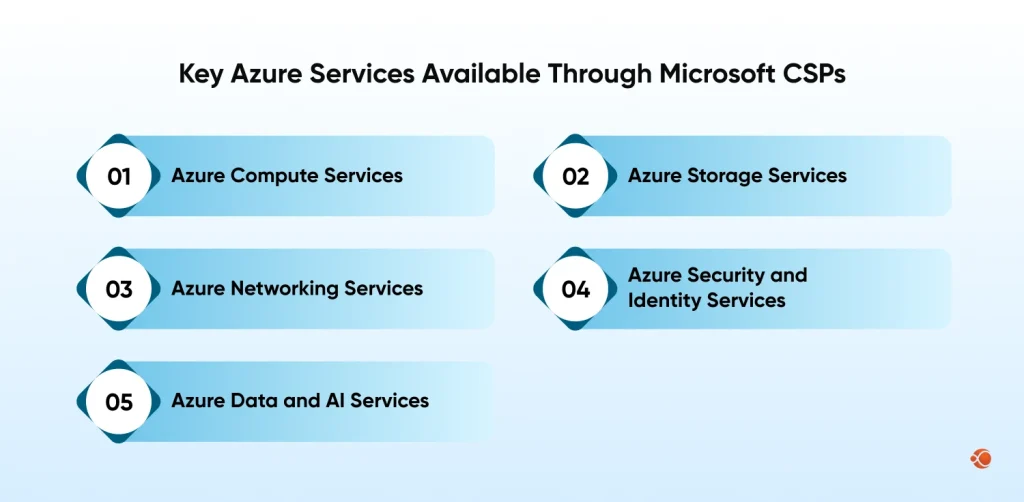
Azure Compute Services: Virtual Machines and App Services
Azure’s computer services let you run applications and workloads without even managing physical servers.
This includes:
- Virtual machines (VMs) for full OS control
- Azure app services for web apps and APIs
- Azure kubernetes service for container orchestration
A CSP can help you determine the right compute model and handle scaling, updates and optimization.
Azure Storage Services: Blob, File, and Backup Solutions
Azure offers multiple storage options for different needs:
- Blob Storage for unstructured data
- File Storage for shared file systems
- Disk Storage for VMs
- Azure Backup and Site Recovery for data protection
Your CSP can be designed in such a way that helps in storage solutions that balance cost, durability and performance.
Azure Networking Services: VPN, VNet, Load Balancer, and ExpressRoute
Networking is the backbone of any cloud setup. Azure provides:
- Virtual Networks (VNet)
- Load balancers and Application gateways
- VPN gateways for secure connections
- ExpressRoute for private, high-speed links to Azure
CSPs are designed and manage these networks to make sure security, reliability and performance.
Azure Security and Identity Services: Active Directory, Defender, and Sentinel
Security in Azure is built around identity and monitoring:
- Azure Active Directory (now Microsoft Entra ID) for identity management
- Microsoft Defender for Cloud for threat protection
- Microsoft Sentinel for SIEM and security analytics
A CSP can access controls, security monitoring and configure policies based on your risk profile and compliance needs.
Azure Data and AI Services: SQL, Synapse, and AI Tools
For data-driven businesses, Azure offers:
- Azure SQL Database and Managed Instance
- Azure Synapse Analytics is used for data warehousing and big data
- Azure AI services for vision, speech, language, and machine learning
CSPs often help design data architectures, migrate databases, and deploy analytics or AI solutions.

Business Benefits of Partnering with a Microsoft CSP for Azure
Reduced IT Operations and Management Workload
Managing cloud environments takes time. Even the simple tasks like patching,monitoring, and backups can consume hours every week.
Your internal IT team can focus on the following tasks, while CSP handles the operational tasks.
- Product development
- Process improvement
- Customer experience
- Strategic initiatives
This is where Microsoft development services offered by experienced CSP partners become especially valuable, as they combine cloud management with application and platform expertise.
Improved Cloud Security and Regulatory Compliance
Security threats keep evolving. CSPs stay up to date with Microsoft’s latest security features and best practices. They help:
- Apply security baselines
- Monitor for threats
- Respond to incidents
- Maintain compliance controls
This is especially useful for organizations in regulated industries.
Predictable Azure Monthly Costs and Budget Control
Monthly billing and proactive cost management reduce financial surprises. Many CSPs also help forecast future spend based on usage trends and business plans.
Access to Certified Microsoft Azure Experts
The professionals used by CSP partners are Microsoft-certified and work with Azure on a daily basis. Such expertise is hard to maintain in-house, especially for smaller teams.
For companies that need extended technical capacity, hire dedicated developers who work closely with internal teams on cloud and application initiatives.
Azure Pricing Models Under the Microsoft CSP Program
Pay-As-You-Go Azure Billing Through CSPs
This is one of the most flexible pricing models. You pay only for what you use, with no long-term commitment, which makes it right for development, testing, seasonal workloads or environments where usage changes often.
CSPs add value by recommending rightsizing when workloads grow or shrink, monitoring usage patterns and flagging unusual cost spikes and helping in setting budgets and alerts so teams don’t face unexpected charges. This model works well for businesses that want agility without financial lock-in.
Azure Reserved Instances and Savings Plans via CSP
Azure provides Reserved Instances and Savings plans for workloads that run continuously, which can minimize costs by 72 % compared to pay-as-you-go rates.

Reserved Instances work well for predictable workloads like production servers or core databases or production servers, while Savings plans give more flexibility by allowing you to commit to a certain spend level while still changing resource types.
A CSP analyzes your usage history, identifies which workloads are suitable for reservations, balances cost savings with operational flexibility and tracks renewals to recommend adjustments over time. This helps you save money without overcommitting.
Azure Cost Management and Optimization Tools
Azure includes built-in cost management tools such as budgets, alerts, cost analysis dashboards, and resource tagging. Many CSPs go a step further by offering custom dashboards, regular cost review sessions, optimization roadmaps, and internal chargeback or showback models for different teams. Microsoft’s official Azure cost management documentation is a useful reference here, and CSPs typically build on it with real-world insights and hands-on optimization support.
Azure Migration and Onboarding Services Through CSPs
Azure Readiness Assessment and Migration Planning
Migration isn’t just about moving servers. It starts with understanding:
- Your current infrastructure
- Application dependencies
- Performance requirements
- Compliance needs
CSPs usually perform readiness assessments using Microsoft tools like Cloud Adoption Framework and Azure Migrate.
Azure Workload Prioritization and Architecture Design
Not all workloads should move at the same time or in the same way. Some may be rehosted, others rearchitected or refactored. CSPs help prioritize workloads and design target architectures that balance speed, cost and long-term value.
Azure Data Migration and Application Modernization
For huge databases or legacy systems, data migration can be complex.
CSPs handle:
- Data transfer planning
- Downtime minimization
- Validation and testing
Also, they help modernize applications using cloud-native services, containers or managed databases.
Post-Migration Azure Optimization and Ongoing Support
Migration isn’t the end. It’s the beginning of a new operating model. CSPs continue to:
- Monitor performance
- Optimize costs
- Improve security
- Support ongoing changes
This ongoing partnership is one of the main reasons organizations choose CSPs.
Real-World Use Cases of Azure with Microsoft CSPs
Azure for Startups and New Cloud Adoption
Startups many times need to move fast with limited budgets and small teams. CSPs help them:
- Set up Azure quickly
- Avoid common mistakes
- Keep costs under control
- Scale smoothly as they grow
This allows engineers and founders to emphasize on developing products instead of managing infrastructure.
Azure for Enterprise Cloud Migration Projects
Large organizations often have complex environments with hundreds or thousands of workloads. CSPs provide:
- Structured migration programs
- Governance frameworks
- Security baselines
- Ongoing optimization
This minimizes the risk and improves the chances of long-term success.
Hybrid and Multi-Cloud Azure Deployments
Many enterprises run hybrid environments that combine on-premises systems with Azure and sometimes other clouds, CSPs help in designing and managing:
- Hybrid networking
- Identity integration
- Unified security policies
- Consistent management tools
Azure Disaster Recovery and Business Continuity Solutions
Azure provides strong disaster recovery and backup capabilities. CSPs develop DR plans that satisfy the recovery point and recovery time objectives and validate and modify them as business requirements evolve.
Azure for AI, Data Analytics, and App Modernization
Organizations increasingly use Azure for advanced analytics, machine learning, and modern app development. CSPs help:
- Build data pipelines
- Deploy AI models
- Modernize legacy applications
- Integrate new digital services
This is where innovation often accelerates.
Security, Compliance, and Governance in CSP-Managed Azure Environments
Built-In Azure Security Features and Tools
Azure includes security features across all layers:
- Identity and access management
- Network security
- Threat detection
- Compliance monitoring
Azure Compliance Standards: ISO, GDPR, HIPAA, SOC, and More
Azure supports a huge range of compliance standards, including ISO 27001, HIPAA, GDPR, SOC, and many others. Microsoft publishes detailed compliance documentation, which CSPs use to help customers meet regulatory requirements.
Role of CSPs in Azure Governance and Policy Management
Governance ensures that cloud usage aligns with business rules and regulatory requirements. CSPs help:
- Define resource naming standards
- Apply policies and role-based access controls
- Enforce tagging for cost tracking
- Monitor compliance continuously
This reduces risk and improves operational consistency.
How to Choose the Ideal Microsoft CSP Partner for Azure
Evaluating Microsoft CSP Technical Expertise and Certifications
Look for partners with:
- Microsoft Azure certifications
- Proven experience across your workloads
- References or case studies in your industry
Certifications alone aren’t enough, but they’re a good starting point.
Industry-Specific Experience with Azure Solutions
A partner who is familiar with your industry will be able to foresee challenges and requirements for regulation more accurately. Whether it is healthcare, financial, retail, or manufacturing, it makes a difference that they have knowledge of your industry.
Support Models, SLAs, and Customer Service Standards
Ask about:
- Support hours
- Response times
- Escalation processes
- Availability of dedicated account managers or technical contacts
Clear SLAs help set expectations and avoid misunderstandings later.
Managed Services and Azure Consulting Capabilities
Some CSPs focus mainly on licensing, while others offer full managed services and consulting. Choose based on how much support you want and need.
Common Azure Challenges and How CSPs Solve Them
Managing Azure Cost Overruns
Uncontrolled cloud spending is one of the most common problems. CSPs address this through:
- Cost visibility and reporting
- Budget alerts
- Rightsizing recommendations
- Reservations and savings plans
Closing Azure Skills Gaps
Cloud skills are in high demand. CPS fills these gaps with certified professionals who bring experience from various customer environments. This is where businesses turn to partners that offer AI software development services along with cloud management, so both infrastructure and applications evolve together.
Reducing Azure Migration Risks
Migrations can fail due to poor planning, testing, or execution. CSPs reduce risk by:
- Using structured frameworks
- Performing pilots and proofs of concept
- Testing thoroughly before cutover
- Providing rollback plans
Addressing Cloud Compliance and Governance Concerns
Regulatory requirements can be difficult. CSPs help interpret compliance standards and implement the necessary technical and operational controls.
Future Trends in Azure and the Microsoft CSP Ecosystem
Growth of AI and Automation on Microsoft Azure
Azure continues to expand its AI and automation services, including machine learning, generative AI and intelligent automation. CSPs will play a main role in helping organizations adopt these technologies effectively and responsibly.
Expansion of Managed Cloud Services by CSPs
As cloud environments grow more difficult, demand for managed services continues to rise. CSPs are expanding their offerings to include:
- FinOps and cost management
- Security operations centers (SOC)
- Data platform management
- Application modernization services
This also includes helping teams build a serverless web app in Azure, reducing infrastructure overhead while improving scalability and performance.
Partner-Driven Digital Transformation with Azure
Digital transformation is not about technology only. It’s about changing how organizations work, serve customers and compete. CSPs increasingly act as transformation partners, not just cloud providers.
Why Choose CMARIX as Your Microsoft CSP Partner for Azure
At CMARIX, we have hands-on experience, certified experts in Azure, and a cloud management approach that is centered around real-world business results, not just technology implementations.
You get proactive cost management, best security practices, and support that actually feels like it’s there for you. And if you’re migrating, optimizing, or scaling, our development team will work alongside you to ensure that your Azure infrastructure is running in top shape and getting even better with time.
For companies looking to build their technical staff, CMARIX can also assist in recruiting full stack developers who have experience with cloud infrastructure as well as new-age application development.
Conclusion
Success in the cloud is more than just making the right choice of platform. It’s about how you use it, how you manage it, and how you grow with it over time. If you’re serious about getting real value out of Azure, from building AI-driven enterprise apps using Azure to cost optimization, having the right CSP partner can make all the difference. Sometimes, having the right partner alongside you is what makes the cloud a growth engine.
FAQs on Azure with Microsoft CSPs
What is Microsoft CSP in Azure?
Microsoft CSP is a partner program that lets businesses buy, manage, and support Azure services through certified partners instead of directly from Microsoft. It also simplifies billing, support, and service management under one partner.
How Microsoft CSP helps optimize Azure costs?
A CSP monitors usage, rightsizes resources, applies savings plans, and prevents waste through active cost management. Partners like CMARIX add value through regular cost reviews and optimization planning.
How does a Microsoft CSP help optimize Azure costs?
They provide detailed billing insights, recommend cost-saving options, and adjust resources based on real usage patterns. This makes sure cloud spend stays aligned with business goals.
What are the key benefits of using Azure through a Microsoft CSP?
You get flexible billing, expert support, better cost control, and faster cloud scaling. With CMARIX, you also get hands-on guidance and ongoing Azure management.
Can Microsoft CSP help with Azure innovation and modernization?
Yes, CSPs guide cloud modernization, AI adoption, data platforms, and app upgrades using Azure-native tools. CMARIX supports this with migration expertise and modernization roadmaps.
Is Microsoft CSP suitable for enterprises and growing businesses?
Absolutely, it works well for both large enterprises and fast-growing businesses that need scalable, managed cloud solutions. It adapts easily as business needs and workloads grow.