




Quick Summary: Today, we explore the key differences between custom AI agents and off-the-shelf solutions to help you choose the right approach for your business. Learn how CMARIX’s hybrid AI framework combines the best of both worlds to drive automation, scalability, and competitive advantage.
AI adoption is accelerating across every industry, but one strategic decision can define your long-term success. And that decision comes down to choosing between custom AI agents vs. off-the-shelf solutions. As enterprise leaders focus on scaling automation, personalization, and AI-driven workflows, choosing between custom AI solutions and ready-made products offers two paths: one (custom AI) offers innovation and deeper exploration, while the other (off-the-shelf) provides speed and a faster time-to-market advantage.
Moving forward, this decision becomes even more important as AI agents are evolving from simple automation bots to fully capable systems that reason, act, learn, and collaborate with complex infrastructure. This guide breaks down both approaches, discusses the benefits, cost considerations, real-world use cases, and the strategic enterprise AI agents implementation framework used by leading AI agent development companies like CMARIX.
What Are AI Agents and Why Are They Important?
AI agents are autonomous software systems capable of understanding data, making decisions, and carrying out tasks with minimal human involvement. Modern AI agents are powered by LLMs, real-time analytics, and machine learning integrations across enterprise systems.
They are important because:
- Enterprises that work with agents can ease collaboration across different workflows.
- AI customer service, procurement allocation, sales intelligence, and predictive analytics are all powered by AI agents.
- Modern systems demand dynamic, adaptive systems, not traditional static software.
AI Agent Development Market Share and Key Statistics
- The global AI agents market was US$5.40 billion in 2024 and is expected to reach US$50.31 billion by 2030, at a CAGR of 45.8%.
- The U.S. AI agents market alone is estimated to be US$1,603 million in 2024, with a projected CAGR of 43.3% (2025–2030).
- The enterprise “agentic AI” market was around US$2.58 billion in 2024 and is expected to grow to US$24.50 billion by 2030 (CAGR 46.2%), per Grand View Research.
- The agentic AI market is forecasted to expand from US$6.23 billion in 2024 to US$107.28 billion by 2032, at a CAGR of 42.85%
What are Custom AI Agents?
Custom AI agents are built and configured specifically for an organization’s internal workflow, data system, compliance requirements, and long-term automation goals. They are engineered to support unique processes that generic, one-fits-all tools cannot handle.
Examples of Custom AI agents:
- Industry-specific reasoning engines
- AI underwriting systems
- Custom outfit generator AI designed for fashion personalization
- Multi-agent enterprise frameworks
- AI-driven compliance automation
What are the Benefits of Custom AI Agents?
Custom AI agents are engineered around an enterprise’s data, workflows, and operational logic, making them a far more strategic investment than automation tools. Here are a few pros of custom AI agent development that you should know:
- Tailored to Enterprise Workflows: Just as a tailored shirt fits better, custom AI agents align precisely with business workflows.
- Enhanced Data Insights and Integration: Custom AI agents can unify internal data and deliver deeper insights. They integrate smoothly with business systems like ERPs, CRMs, and proprietary systems.
- Strengthened Data Security and Ownership: Organizations get full control over data pipelines and model environments. This improves security, reduces third-party exposure, and ensures adherence to strict industry guidelines.
- Greater Scalability: Custom agents can adapt and grow as operational needs evolve, supporting new features, workloads, and multi-agent workflows.
- Improved Performance and Accuracy: Since they are trained on proprietary datasets and aligned with domain logic, custom AI agents are far more accurate. They adapt quickly to changing patterns, improving decision quality and reducing chances of error in high-impact processes.
We create intelligent apps with robust AI integration, transparent costs, and scalable architecture to drive innovation for your business.
Contact UsReal-World Examples of Custom AI Agents
| Company | Type of Custom AI Agent | What the Agent Does | Real Impact |
| Amazon | Fulfillment & Robotics Agents | Coordinate warehouse robots, optimize picking routes, manage inventory in real time | Faster fulfillment, reduced errors |
| Netflix | Personalization & Recommendation Agents | Curate homepages, personalize thumbnails, predict viewing preferences | Higher engagement, longer watch time |
| Tesla | Autopilot Decision & Vision Agents | Process camera feeds, detect objects/lanes, make driving decisions | Improved autonomous driving accuracy |
| Google (DeepMind) | Data Center Optimization Agents | Control cooling systems, adjust energy usage dynamically | Up to 40% reduction in energy costs |
| Walmart | Supply Chain & Inventory Agents | Predict demand, automate restocking, optimize deliveries | Fewer stockouts, efficient logistics |
| Uber | Pricing & Dispatch Agents | Match riders/drivers, forecast surge areas, set dynamic fares | Faster rides, optimized driver distribution |
| Spotify | Music Curation & Personalization Agents | Analyze listening patterns, recommend songs, build auto-curated playlists | Highly personalized user experience |
| Meta (Facebook) | Moderation & Feed Ranking Agents | Detect harmful content, rank posts/videos, manage spam | Safer platform, relevant content feed |
What are Off-the-Shelf AI Agents?
Off-the-shelf agents are pre-built, commercially available AI agents embedded within software suites or platforms. These agents typically automate routine workflow but lack deep alignment with any company’s specific internal logic, data flows, and strategic value levers.
Examples of off-the-shelf AI agents:
- Chatbots from SaaS providers
- Generic AI Agents inside CRM platforms
- Prebuilt AI customer service tools
- Standard AI models for sentiment analysis or text summarization
What are the Benefits of Investing in Off-the-Shelf AI Agents
- Speed of deployment: Off-the-shelf solutions can be implemented in a matter of days or weeks, allowing businesses to get AI capabilities up and running quickly.
- Vendor maintenance: Ongoing maintenance, bug fixes, updates, and even training are handled by the provider, shifting the burden and related costs from internal upkeep to the business.
- Proven frameworks: These solutions are often tested and refined across many users, leading to increased reliability and reduced risk compared to a new custom build.
- Ease of use: Most commercial agents have friendly interfaces. Installation and usage involve less technical knowledge.
Real-World Examples of Leading Off-the-Shelf AI Agent Platforms
| Tool / Platform | Category | What It Does (Out-of-the-Box) | Typical Use Cases |
| Salesforce Einstein | CRM AI | Lead scoring, sales forecasts, next-best actions, automated insights | Sales teams, CRM optimization |
| Microsoft Copilot | Productivity AI | Summaries, presentations, Excel analysis, email drafting | Office workflows, enterprise productivity |
| Google Workspace AI (Gemini for Workspace) | Office Productivity AI | Writing, summarizing, Sheets analysis, creative generation | Email, documentation, collaboration |
| Zendesk AI | Customer Support AI | Auto-replies, ticket classification, routing, agent suggestions | Customer service & support teams |
| HubSpot AI | Marketing & Sales AI | Content creation, lead scoring, campaign optimization | Marketing automation, CRM workflows |
| Shopify Sidekick | eCommerce AI | Product descriptions, store recommendations, merchant assistance | Online store management |
| Notion AI | Knowledge & Task AI | Summaries, content generation, rewrites, task creation | Notes, documentation, personal productivity |
| Adobe Firefly | Creative AI | Image generation, design variations, generative editing | Designers, marketers, creatives |
| Slack AI | Collaboration AI | Channel summaries, knowledge search, response drafting | Internal communication, team knowledge retrieval |
| ServiceNow Now Assist | ITSM & Operations AI | Ticket resolution, incident summaries, workflow recommendations | IT operations, enterprise service management |
Our team builds AI-driven apps tailored for performance, clarity, and future scalability.
Contact UsCustom AI Agents vs. Off-the-Shelf Solutions
When companies consider AI solutions today, most decisions boil down to two strategic paths: adopt an off-the-shelf AI platform or build a custom AI agent tailored to the business. Both deliver value, but in very different ways. Below is a practical comparison across core business dimensions, expanded with real operational considerations teams face in insurance, finance, compliance, logistics, and enterprise environments.
1. Accessibility & Cost
Off-the-shelf AI: These solutions typically follow a subscription or pay-as-you-go pricing model. They are affordable at the start, but often escalate in cost based on factors like user seats, usage volume, advanced features, or enterprise add-ons.
Custom AI: Custom AI development requires a higher upfront commitment covering data preparation, model development, and system integration. Once deployed, it eliminates the need to escalate to higher licensing tiers or to work around vendor restrictions. Industries with high document volumes, such as insurance policy analysis or enterprise compliance, gain a clear long-term benefit.
2. Deployment Speed
Off-the-Shelf AI: These AI agents are built with speed and precision in mind. For companies that can’t waste time setting up and understanding the architecture of AI agents, many off-the-shelf AI tools can be activated within days or weeks. It is ideal for exploring specific use cases, such as basic legal clause tagging or quick-start demand forecasting.
Custom AI: Custom AI agent development takes longer because it requires secure pipelines, workflow alignment, compliance checks, and model refinement. These projects can take many months, but once the systems are deployed, they naturally align with how teams already work, leading to stronger adoption.
3. Customization & Flexibility
Off-the-Shelf AI: Most off-the-shelf platforms are built on standard business workflows. They function best when your operations fit their pre-defined labels or processes. If you need specialized risk factors, unique legal structures, or jurisdiction-specific rules, these tools may require manual workarounds.
Custom AI: Every component can be shaped around your requirements. This includes taxonomies, thresholds, permissions, scoring logic, and even compliance rules. Industries that constantly deal with technical contract language or special underwriting models will benefit greatly from this flexibility.
4. Competitive Advantage
Off-the-Shelf AI: These solutions give organizations access to common capabilities that any competitor using the same tools can achieve. This provides parity with competitors but no differentiation.
Custom AI: A custom AI agent becomes a proprietary asset built around your internal data and processes. The intelligence it generates is unique to your business, giving you a competitive advantage that cannot be easily replicated.
5. Scalability & Growth
Off-the-Shelf AI: Scaling with off-the-shelf solutions requires moving to higher subscription tiers. Technical limitations also appear in the basic plans of such platforms, including API rate limits, fixed throughput, or a lack of support for real-time data streams.
Custom AI: Custom AI agent solutions are built with growth in mind, since they are trained and developed on your core business logic. They understand the purpose behind every action and decision. They can align support to new departments and markets and handle increased data volume without hitting any external restrictions.
6. Data Ownership, Security & Compliance
Off-the-Shelf AI: Data often flows through vendor systems, and while these platforms are surely secure, direct control is often limited. This can introduce risks in regulated industries such as finance, insurance, and legal, where auditability and data residency are very important.
Custom AI: All data remains within your approved environment with defined encryption policies, access levels, audit trails, retention rules, and compliance mappings for GDPR, HIPAA, SOC-2, and other regional regulations.
7. Maintenance, Upgrades & Control
Off-the-Shelf AI: Vendors can handle updates, patches, new features, and UI changes. This reduces technical overhead but also reduces control. Updates may alter workflows or introduce changes that do not align with business priorities.
Custom AI: You control upgrade cycles, model retraining schedules, feature development, and bug fixes. This ensures that system evolution is directly aligned with business goals and not vendor timelines.
8. Integration Depth
Off-the-Shelf AI: Most off-the-shelf solutions provide limited connectors that integrate with popular systems such as CRMs or document storage tools. More specialized or legacy platforms usually require additional manual steps.
Custom AI: Integrations are built specifically for your environment, whether it is a legacy claims system, a proprietary logistics engine, or a specialized legal database. This reduces data silos and supports complete workflow automation.
9. Accuracy & Domain Expertise
Off-the-Shelf AI: The models used for off-the-shelf AI are trained on general-purpose datasets. Accuracy may be acceptable for standard cases, but it often decreases when domain-specific terminology or edge cases arise.
Custom AI: Models are trained on your historical data, internal rules, and domain language. This typically results in higher accuracy, more relevant predictions, and stronger decision support.
10. Long-Term Strategic Fit
Off-the-Shelf AI: These tools work well for quick wins or teams with straightforward needs. However, long-term transformation is limited by feature availability and vendor roadmaps.
Custom AI: Custom AI agents scale alongside the organization. As new requirements emerge, such as new markets, regulatory changes, or expanded data sources, the AI can be retrained or modified without limitations.
Custom AI Agent vs Off-the-Shelf AI Quick Comparison Summary Table
| Category | Off-the-Shelf AI | Custom AI |
| Cost | Lower initial, higher scaling | Higher initial, efficient long term |
| Deployment Speed | Fast | Slower but precise |
| Customization | Limited | High |
| Competitive Advantage | Parity | Differentiation |
| Scalability | Restricted | Built for growth |
| Data Control | Vendor governed | Full ownership |
| Compliance | General | Domain aligned |
| Maintenance | Vendor led | Business controlled |
| Integration | Limited connectors | Deep integrations |
| Accuracy | Generic | Domain trained |
| Governance | Less transparency | Full clarity |
How to Choose the Best Fit AI Agent Development Approach for Your Industry
Choosing between custom AI agents and off-the-shelf AI solutions depends entirely on the level of specialization within each industry’s workflows, data environments, and compliance needs.
While each industry can benefit from both custom and off-the-shelf AI agents, here is a simple breakdown of which approach delivers the most value for certain popular industries.
Industries Suited for Custom AI Agents
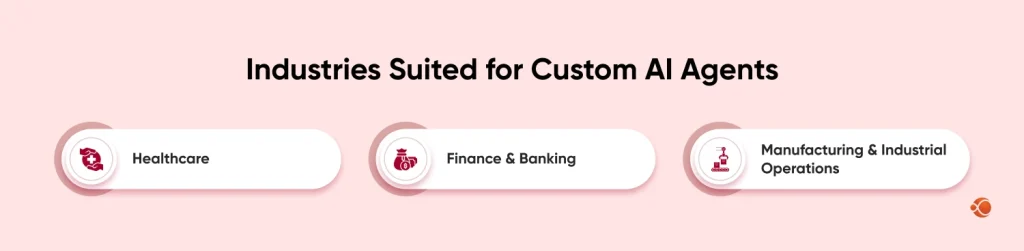
Healthcare:
- AI triage and symptom checking.
- Help doctors with diagnostics and documentation.
- Support remote monitoring and follow-ups.
Finance & Banking:
- Fraud detection and risk checks.
- Personalized financial advice and insights.
- Automate compliance and reporting.
Manufacturing & Industrial Operations:
- Predictive maintenance for machines.
- Real-time production planning and routing.
- Automated quality inspection and alerts.
Industries Suited for Ready-to-Use Solutions
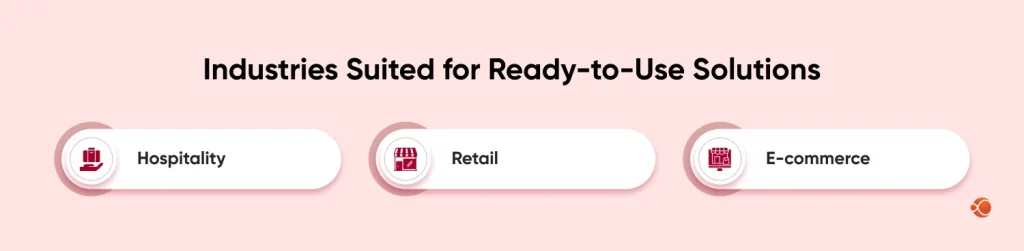
Hospitality:
- FAQ and booking chatbots.
- Guest communication and concierge.
- Review and feedback handling.
Retail:
- Product search and recommendations.
- In-store or online customer support.
- Inventory and basic demand suggestions.
E-commerce:
- Product recommendations and bundles.
- Cart recovery and promo recommendations.
- Order tracking and support chat.
Total Cost of Ownership (TCO) Comparison: Custom AI vs Off-the-Shelf Agents
One of the biggest mistakes organizations make when evaluating the cost-effectiveness of custom vs. off-the-shelf AI solutions is failing to consider the full lifecycle costs. Instead, long-term AI investment decisions should be factored in based on TCO (total cost of ownership).
| TCO Dimension | Off-the-Shelf AI | Custom AI Agents |
| Upfront Cost | Low initial cost (subscription-based, no training needed) | Higher upfront investment (data prep, model training, integrations) |
| Licensing & Scaling Costs | Recurring subscriptions; costs increase with usage, seats, and advanced features | No per-user licensing; scaling tied mainly to infrastructure costs |
| Integration Costs | Limited connectors; deeper integrations require extra development or middleware | Built specifically for internal systems; lower long-term integration overhead |
| Maintenance & Upgrades | Vendor-managed updates but limited control; changes may disrupt workflows | Fully controlled; updates scheduled based on business needs |
| Infrastructure Costs | Included in subscription but with limits on throughput, processing, or custom logic | Cloud or on-prem infrastructure costs; optimizable over time |
| Data Management & Compliance Costs | Additional cost for compliance add-ons, logs, security tiers | Full data control; compliance aligned with internal rules without extra fees |
| Customization Costs | Very limited; requires costly external plugins or manual workarounds | Fully customizable across logic, workflows, and data flows |
| Security & Risk Costs | Vendor dependency increases long-term risk and potential compliance exposure | Lower risk; all systems operate inside controlled enterprise environments |
| Workflow Automation Depth | Surface-level AI automation | Deep automation across custom workflows |
| Vendor Lock-In | High (roadmap + pricing constraints) | None (full autonomy) |
| 5-Year TCO Forecast | Higher for enterprises with heavy usage due to subscription escalation | Lower and predictable due to controlled infra + no licensing escalation |
This metric provides a complete view of the costs of deploying, maintaining, and scaling an AI agent system over successive years. TCO is important for enterprises that expect AI agents to integrate deeply within their operations, support mission-critical workflows, or manage sensitive datasets.
CMARIX’s Hybrid Enterprise AI Framework: Custom and Off-the-Shelf Agents
The neat part of choosing the right AI agent path for your enterprise is that you don’t need to choose one over the other. Most of the strongest AI transformation strategies blend both together. At CMARIX, we use a hybrid Enterprise AI agents implementation framework that aligns business goals with the right mix of pre-built tools and highly tailored AI agent development.
Why Hybrid AI is the Most Strategic Path for 2026 and Beyond
- Speed from Off-the-Shelf Tools: Deploy core AI capabilities instantly without long development cycles.
- Differentiation from Custom AI Agents: Build proprietary, domain-trained agents that create a defensible competitive advantage.
- Balanced Cost Structure: Reduce upfront costs with prebuilt tools while custom agents minimize long-term TCO and vendor lock-in.
- Future-Proof Architecture: A hybrid AI setup evolves seamlessly with new regulations, data sources, and business needs.
How CMARIX Implements the Hybrid AI Framework
Our approach blends AI consulting services, machine learning development services, and enterprise-grade engineering to create a coordinated AI ecosystem powered by custom and off-the-shelf agents working together and not in silos.
1. Strategic AI Assessment & Blueprinting
We begin with a comprehensive AI readiness evaluation. Here, we identify where off the shelf solutions can deliver quick wins and where custom AI agents create long-term enterprise value. This helps provide clarity to teams on the AI implementation roadmap, aligned with KPIs, risk levels, and operational constraints.
2. Harmonizing Off-the-Shelf Tools with Enterprise Systems
As an experienced AI agent development company, we integrate the most valuable prebuilt solutions, such as Salesforce Einstein, Copilot, and Zendesk AI, into your existing workflows. This ensures you get the immediate automation benefits while reducing disruption to teams and systems.
3. Building Custom AI Agents for High-Value Workflows
We develop domain-specific AI Agents trained on enterprise data. Here are a few popular types of AI agents you can build with our team:
- Underwriting automation agents
- Logistics optimization agents
- Compliance surveillance agents
- Multi-agent workflows for supply chain, finance, or manufacturing
4. Multi-Agent Orchestration Layer
We build a unified orchestration layer that ensures custom and off-the-shelf agents work collaboratively. This includes:
- Role-based agents
- Tool-using agents
- Secure data access layers
- Workflow dispatchers
- Audit and oversight controls
5. Enterprise-Grade Security, Governance & Compliance
All agents operate within a governed architecture with:
- Keeps full audit trails for transparency and accountability.
- Uses secure data gateways to protect sensitive information.
- Provides detailed role-based permissions to control who can access what.
- Complies with standards like GDPR, HIPAA, and SOC-2 to meet legal requirements.
- Monitors models and tracks risks to spot and reduce potential issues.
6. Continuous Optimization, Retraining & Lifecycle Management
Our AI teams constantly refine model performance, retrain custom agents, and evaluate off-the-shelf tools as vendor updates roll out. Enterprises gain ongoing performance improvements with no disruption.
CMARIx combines enterprise AI consulting, machine learning engineering, and multi-agent systems, making us a trusted AI software development company for enterprise-scale automation.
Why Enterprises Choose CMARIX for Hybrid AI Agent Development
- Strong expertise across custom AI agent development, multi-agent ecosystems, enterprise integration, and LLM-based intelligence.
- Deep industry experience across healthcare, fintech, manufacturing, logistics, retail, and compliance-heavy sectors.
- Ability to blend prebuilt AI tools with tailored agents to create a unified, efficient, and cost-optimized AI landscape.
- Dedicated teams to hire AI developers for specialized long-term engagements.
- Full-spectrum support from AI consulting services to production-scale deployment.
Emerging Trends in AI Agents for 2026 and Beyond
- Multi-agent ecosystems are becoming the standard for enterprise automation, with specialized agents collaborating across departments.
- Agents shift from task assistance to full workflow ownership, handling end-to-end operations autonomously.
- Compliance-aware agents embed regulatory logic, auto-audits, and jurisdiction-based decision rules.
- Advanced agentic reasoning enables deeper planning, scenario simulation, and domain-specific analysis.
- Enterprise knowledge graphs improve context understanding, accuracy, and cross-system decision-making.
- Agents will operate as modular APIs. They will provide smooth automation across ERP, CRM, ITSM, and legacy systems.
- Synthetic data and simulation environments accelerate safe agent training and stress testing.
- Edge-based AI agents will power real-time decisions in manufacturing, logistics, and operations environments.
- Continuous learning agents refine their logic over time, reducing drift and adapting to evolving workflows.
Final Words
As enterprises move into 2026, the question is no longer whether AI agents should be adopted; it’s about selecting the right approach custom AI agents vs. Off-the-shelf solutions) to unlock sustainable competitive value. Off-the-shelf AI delivers speed, while custom AI agents create long-term differentiation, deeper automation, and domain-aligned intelligence. The winning strategy increasingly lies in a hybrid model, where both approaches work together inside a unified AI ecosystem.
FAQs for AI Agent vs Off-the-Shelf Solutions
What is the difference between custom built and off-the-shelf?
Custom-built AI solutions are fine-tuned to a business’s specific needs, data, and workflows. Off-the-shelf AI is pre-built, general-purpose software designed for quick deployment, typically with limited customization options but faster time-to-market.
How to implement off-the-shelf AI?
Implementing off-the-shelf AI involves obtaining proper consultation on the preferred AI tool from a dedicated AI agent development company like CMARIX. Once you have decided on the tool that works best for your project, their developers will configure it to work smoothly with your existing systems, deploying it across customer touchpoints. Many solutions offer plug-and-play functionality, making them easy to set up with minimal technical expertise.
When to choose off-the-shelf AI over custom solutions?
Off-the-shelf AI is ideal for quick deployment of standard tasks like customer support or lead scoring. It’s best for businesses with simpler workflows or for low-cost scalability without deep customization.
Can you integrate custom AI agents with my existing software or CRM?
Yes, custom AI agents can be seamlessly integrated with your existing software or CRM. APIs and middleware allow for smooth data exchange between systems, ensuring that AI agents enhance workflows without disrupting current operations or requiring major overhauls.
Is it possible to start with an off-the-shelf AI solution now and upgrade to a custom AI agent later?
Many businesses start with off-the-shelf AI solutions for quick wins and then upgrade to custom AI agents as their needs grow. Transitioning to a custom AI solution mainly involves expanding AI functionality and fine-tuning it to exact workflow requirements.
How do off-the-shelf AI solutions typically handle data privacy?
Off-the-shelf AI solutions are built with compliance checks for all standard data privacy regulations. However, the level of data control and security is entirely dependent on the vendor. Businesses should review the vendor’s privacy policy and ensure the solution meets their specific compliance and data-residency needs.